





Please note: Display items are part of my personal collection and are not for sale.
My interest in Crown Railways was formed on reading Pat Hammonds trilogy of books depicting the ‘Story of Rovex’. Volume 2 has a brief introduction whereas Volume 3 has much greater detail. I am honoured to have Pat’s permission to use his research in my account of the brand. Click here to read his research.
In the early 2000s I managed to obtain a Crown / Model Railways Passenger Train Set with Tunnel. For the next 25 years, I kept an eye out for more and in early 2026 I managed to acquire an extensive collection, which has sparked a little more research and the addition of this section on my website.
Through the wonders of social media, I managed to contact an Indian model rail enthusiast with a passion for Crown Railways. Mr Tariq Khurdshid from Bombay, who has been very forthcoming with information and photos.
Photos. Most of my own, but I am indebted to the following for use of their photographs.
PEH – Pat Hammond, TCS Archives. CB – Chris Bugby. TK – Tariq Khurshid. FK – Fahad Khan.
Pats research included discussions with Richard Lines, one of the Lines Brothers, who owned Triang Railways. During these discussions, reference was made regarding some old tools being sent to India, to a Mr S Kumar of S.Kumar & Co. (Pvt) Ltd Calcutta. The trail of these tools went quiet for a number of years, so research moved to Crown Railways. A while later a set appeared, made by ‘Electronic Toys (India) (ETI) of Bombay’, with some similarities to Triang models. Via the internet, Pat made contact with Tri-ang enthusiast Mani Shaunik, who was also interested in the Triang India link.
Mani established that Mr. Kumar also owned a business called the India Hobby Centre which included shops in Delhi, Madras, Bombay and Calcutta and that Crown Railways had been manufactured in Bombay by Electronic Toys (India) which was owned by a Mr. Ashwin K. Mehta.
Mani met with Mr. Mehta and established that Crown Railways were manufactured in India during the years 1982 to 1984. Mr Kumar, did have some ex Triang tools and these were passed over to Mr. Mehta to produce models. These were those for the R223 suburban coach, R217 Primary open truck, R218 Primary closed van, R24 TC coach, R25 TC vista dome car, R130 TC baggage car (also called a luggage van) and R153 saddle tank.
Mr. Kumar would market the train sets through his India Hobby Centre chain of shops and Mr. Mehta would sell the trains through various other hobby and toy shops all over India. The first six items were made directly from the Tri-ang moulds and were done in various colours. They were to be exactly like their original counterparts. Although the saddle tank tools were passed to Mr. Mehta it was not produced in the Crown Railways range. See later.
This is the first area my research varies, in that I have models in identical boxes except branded ‘Model Railways OO/HO scale’ but still manufactured by Electronic Toys (India). Some are even printed Crown, covered by stickers. I do wonder if this was to differentiate between the two routes to market, or maybe a later rebranding.
Locally produced items
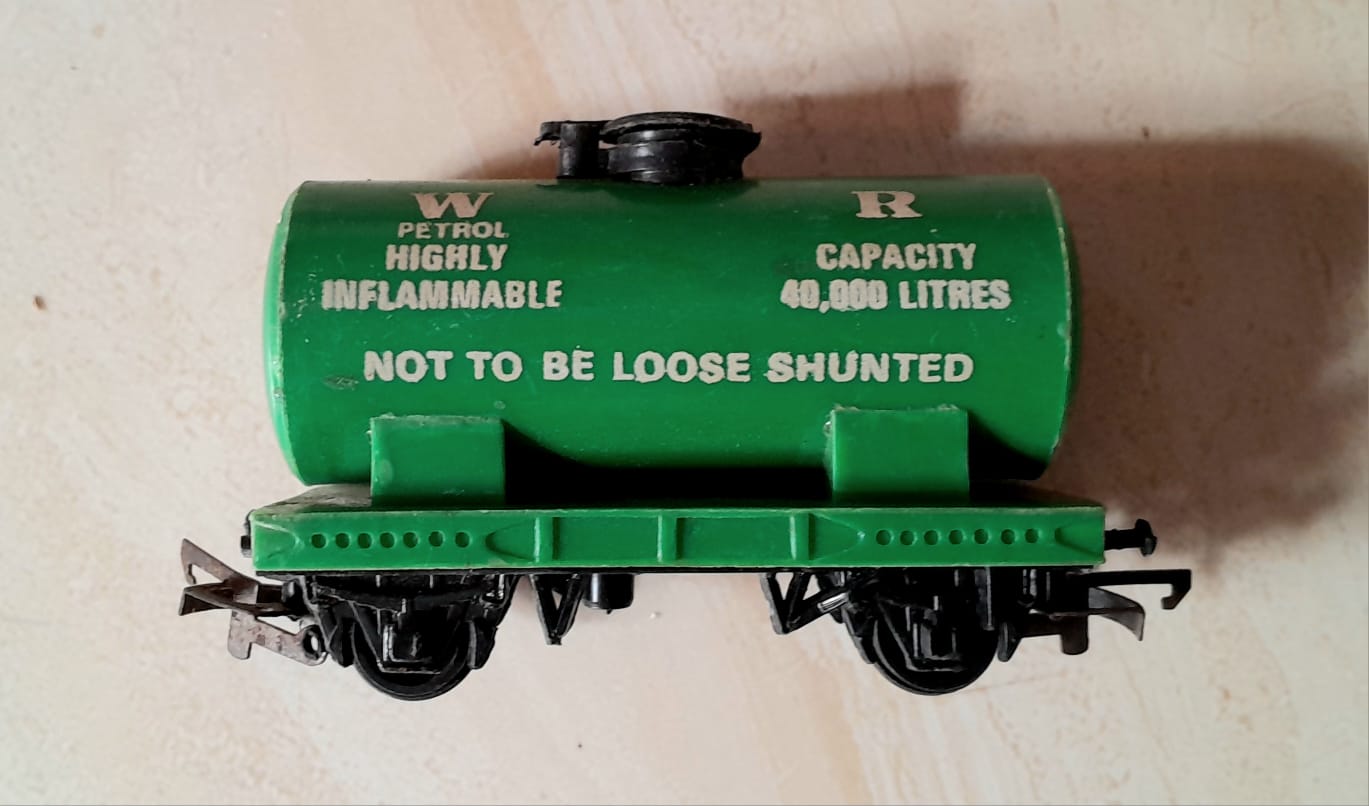
To extend the range a number of locally produced items of rolling stock were produced, the tools being produced by Electronic Toys (India) but marked ETI. They included a flat wagon, open box wagon, closed box wagon, oil tanker, guards van, a 4 wheel coach and a short, bogie, passenger coach.
The wagons were locally designed with the tank wagon and brake van being wider bodies, to represent the local broad gauge railways. The chassis for all of these was a very good copy of the long wheelbase Triang model.
As to the coaches…the 4 wheel model is an excellent copy of the Hornby model, whereas the short bogie one is of uncertain origin. The bogies and underframe appear copies of Triang items but the body is to my eye, more like a Hornby Dublo item, in plastic.
There was only one loco, again an incredible copy of the Hornby R852T Continental 0-4-0 tank engine. So accurately copied, it even has the holes in the tank sides to fit the early Hornby plastic chassis! Sadly they were not able to source XO4 motors, but utilised a poor local 4.5 Volt item. Running allegedly was not good, I have not tried running mine.
The loco came in all the sets and I assume was available individually as it is shown separately on the set boxes. I have variants in both Crown Railways and Model Railways boxes. From photos it appears to have been available with WR or CR stickers (Western / Central Railways)
The track was a big problem. Due to low volumes, it was not possible to produce a solid rail, so they produced rail by folding thin metal sheet, and a plastic sleeper web, again based on Triang Hornby System 6 track. Sadly the track appears to have been the downfall of the range, leading to it’s discontinuation.
The range of track included a straight, small radius double curve and both right- and left-hand points, along with a power clip, again a copy of the Hornby model.
There was a small range of accessories including a straight station platform, platform sloping ends, platform roof, a girder bridge, curved and straight bridge spans, curved and straight approach sections incline piers and bases (to me looking similar to Jouef / Placraft), signal, a fireman and driver in metal (Triang copy), a tunnel – possibly only available in sets (Hornby copy), a streetlight (copied from a Tyco street light) and a catenary post (copied from an old Marklin design).
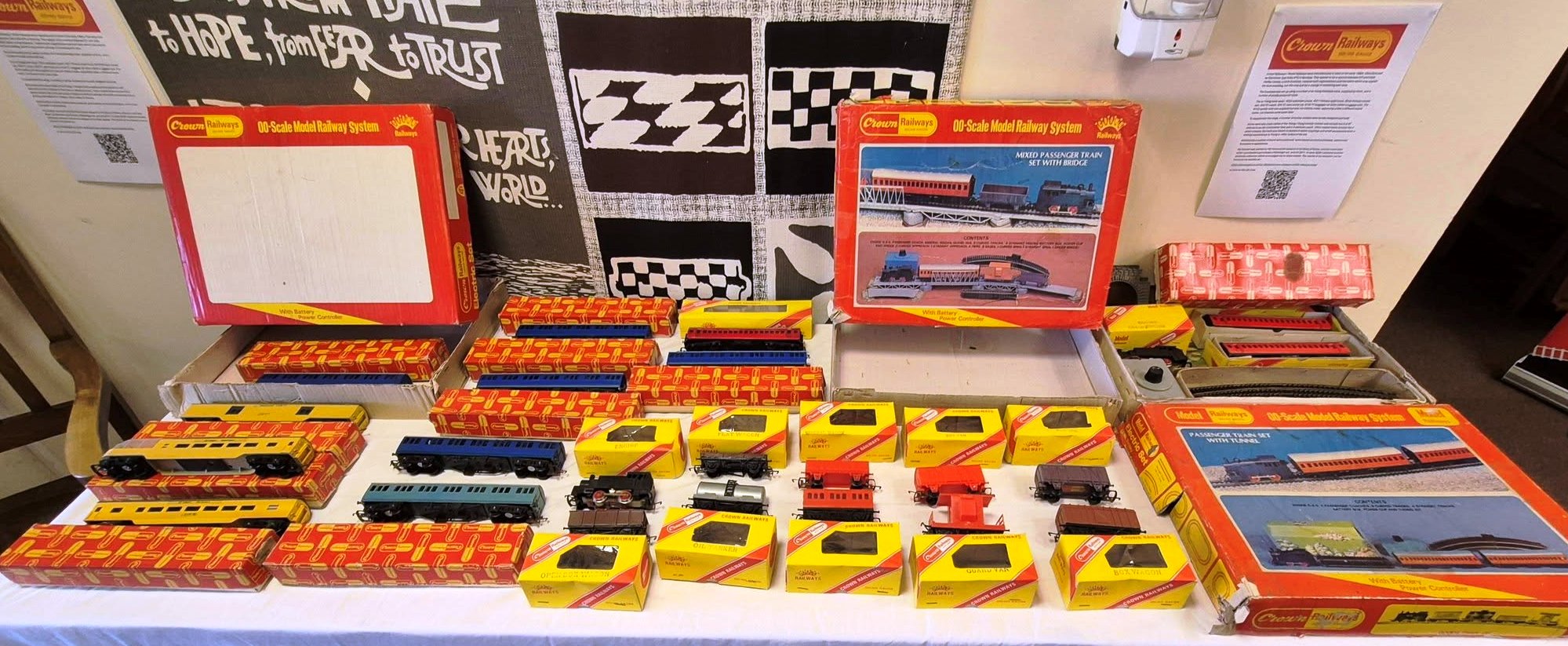
Three train sets appear to have been made. A passenger set consisting of the loco with two passenger coaches, an oval of track, a battery powered controller and a tunnel kit which consisted of two plastic moulded tunnel faces and a cardboard cover. A mixed passenger set with bridge, consisting of the loco, passenger coach, mineral wagon, guards van, track and bridge sections (1 curved approach, 1 straight approach, 6 piers, 6 bases, 1 curved span, 1 straight span and 1 girder bridge) and a battery controller. There was also a freight set, of which very few were made, which had a loco, flat wagon, open box wagon, oil tanker, guards van, an oval of track, a battery powered controller and a girder bridge and pier set.
Electronic Toys (India) finally ceased production of Crown Railways in 1984 when the tools for the rails wore out. They again tried to make a solid rail but ran into the same problem of minimum volumes. The ex-Tri-ang tools were returned to Mr S. Kumar in Calcutta and the Crown Railways stock had all cleared by the late 1980s. The tools were eventually sold for scrap.
This was almost the last model for Electronic Toys (India) but in the 90s they made one more set, the Leo Toys Express train set.
This used the the body mould for the R153 Primary Series saddle tank on a locally designed chassis with an 0-4-0 wheelbase and no connecting rod. The motor was a 3V DC toy motor powered by two pen cell batteries which were mounted inside the loco. There were three of the locally copied 4 wheel coach and an oval of plastic track. These sets were produced in various colours.
Electronic Toys (India) still seem to make the odd batch of these on demand and market them directly to the toyshops in India.
Detailed Information
Further to the overview of the full range, more detailed information and photos are shown in the following sections.
Transcontinental Coaches.
Starting with the Transcontinental coaches. These appear to have been made in various shades of plastic and then painted to the desired colour. I’m aware of yellow, green and what appears to be grey with a black stripe. The Crown Railway logo was printed on self adhesive tape, stuck to the coach sides. Whilst the body was pure Triang, the bogie was locally tooled and to hide the Triang name and R number, a plastic plate was made to cover the detail. They were available individually in boxes.
Suburban Coach.
The suburban coach was again made in various shades of plastic and then painted to the desired colour. I know of shades of blue and pink.
Again the body was pure Triang, the bogie was locally tooled. This time, some of the coaches still had Triang R121/223 visible whilst others appear to show it scraped off – I,m not sure if this was a tool modification or literally removed from the coaches. They were available individually in boxes.
Ex Triang Primary Wagons.
The two ex Triang Primary Wagons, the open wagon and closed van were both produced in shades of brown and a bright red colour.
This time the Triang detail was removed from the underside of the tool, leaving a flat surface that sometimes had a Crown label on it.
They were both available individually in boxes and the open wagon in a set.
Locally Produced 4 Wheel Rolling Stock.
There were six locally designed items of rolling stock; a flat wagon, open box wagon, closed box wagon, oil tanker, guards van, a 4 wheel coach. The guards van and oil tanker were of a larger size, presumably to represent the local broad gauge railways.
I am only aware of the oil tanker being grey and the brake van being red. Other wagons have appeared in shades of brown and red. It appears from pictures and memory that some of the wagons came with CR or WR stickers, probably on clear tape. CR being Central Railways and WR being Western Railways- divisions of Indian Railways.
The wagons were available individually in boxes. The guards van was included in the “Mixed Passenger Train” set. The Open Flat, Open Box, Petrol Tank and Guards Van were in the “Goods” set.
The 4 wheel coach was made in at least red in Crown days. In its later Leo guise it was available in shades or red and cream
As stated above, the chassis was locally tooled, with the ETI logo and “Made in India” moulded on its underside.
Locally Produced Suburban Coach.
There was only one locally tooled bogie coach, the suburban. To me, styled on the Hornby Dublo tin model but made from plastic. However, this wasn’t moulded in one piece but from individual sides, doors, ends, chassis and roof which were glued together. It is quite a crude model!
I know of plain red and maroon / cream liveried models. Some were decorated with an Indian Railways logo that appears to be printed on a paper sticker.
They were included in the “Mixed Passenger Train” and “Passenger Train” sets. I believe they were also available separately in boxes, but am aware that those in sets were individually boxed within the set. Boxes marked Crown Railways and Model Railways can be found.
As stated above, the chassis was locally tooled, but unlike other models do not appear to have ETI legend on them, unless it was in label form, since lost.
Additional Set, Accessory and box Information.
I am aware of a few variations of the sets. Apart from being in Crown or Model Railway boxes, at least some came in plain brown boxes with just a label to signify their contents. these boxes were made from poor quality, sometimes re-used carboard. The outer edges were used to advertise other items in the railway range.
The battery control box was also available in blue. There was also an instruction sheet included, a fold out leaflet of six pages.
The tunnel was very much like the Hornby model of the time, two plastic ends and a card tunnel, that I can not make fit together!
The power clip was pure Hornby copy too.
Private Collections
A few photos of private collections of the guys who helped provide information for this page. Thank you
Large Triang TT Collection just in – please ask
It appears some email servers may place my Quote replies in your spam / junk folder! If you submit a quote, I will always respond, so please check your spam / junk folder.